
»There Are No Politics That Are Not Body Politics« – The Urge to Come Together
Neda Kovinic in conversation with Ariana Dongus
In the following text, art historian Anna Kipke explores the intricate textures of Agnieszka Mastalerz’s moving image artwork »Mould« (2025) and the life of Polish dancer and sculptress Danuta Kwapiszewska. Mastalerz, a Solitude Fellow in 2025, screened »Mould« during her first international solo exhibition at the Fort Institute of Photography in Warsaw (2025). Kipke’s analysis delves into how vulnerability can catalyze transformation. Through a poetic examination of Danuta’s life and a nuanced reading of Mastalerz’s film, she asks: How do fragile moments of rupture – whether bodily, material, or artistic – generate new forms of movement, representation, and continuity? Her reflections weave together the legacies of both artists, revealing unexpected resonances between their practices.
Anna Kipke — März 4, 2026
Physical and health crises often relate to the notion of trauma as a kind of rupture, indicating a loss of visual representation. Recently, new perspectives in the interdisciplinary field of trauma studies suggest otherwise, as they explore a broad range of existing representations of individual and collective crisis in performance, literature, and art1. In her latest film Mould (2025), Agnieszka Mastalerz conceptualized and produced a choreography of two bodies as they immerge in a spiral of improvisation, closeness, and touch. Drawing on the life and artistic practice of the Polish dancer and sculptress Danuta Kwapiszewska (1922–1999), Mastalerz addresses the ruptures and physical limitations within Kwapiszewska’s life, urging her to turn her practice from dance to sculpture, exceeding the non-representational realm. Within the representational setting of a stage, Mould turns our attention to the transformational power of movement in a concentrated form of attention.
Shot on 35mm celluloid analogue film, Mould presents a choreography of two female dancers as their performance is projected as a bright moving image in the dark exhibition space. In the first part of the film, a single dancer slowly spins into the frame like a static sculptural object standing on a pedestal. Suddenly, the dancer starts to create her own movements while the close-up camera slowly moves away from the choreographer, losing its proximity to the subject. Then, a second dancer joins the choreography on stage. While the camera is moving in a circular motion mainly around the upper part of the protagonists’ bodies, the camera‘s visual principle seem to be an indecision between closeness to and distance from the subject of attention. Within these shifts and changes, dynamics of attraction and repulsion between the camera, the dancers and the viewer unfold, mapping a spectrum of minimalist and maximalist tension. The dancers’ movements synchronize easily, taking up each others’ gestures as if the draft of the choreography only realizes itself when the bodies are in motion.
Mould’s choreography is part of a thoroughly reduced constellation of spatial elements: the soft light from the ceiling, sound recordings used only from the set, and the visible camera tracks underline the formalist approach pointing to the conditions of film production as a medium. Recently presented at Fort Institute of Photography in Warsaw, this reduced form found its continuation within the exhibition space. The black box presentation, where the film is displayed in the darkened gallery space, produces a condensed form of attention in which the viewer’s gaze is focused solely on the screen. Together with the film projector’s mechanical sound, this form of presentation sets the rhythm within the exhibition space. The projector’s monotonous repetition produces a soundscape that contrasts with the smooth, tender, seemingly silent movements of the two protagonists.
Agnieszka Mastalerz, »Mould«, solo exhibition, Fort Institute of Photography, Warsaw, 2025. Photo: Julia Pietrzak-Szczudło. Courtesy of the Artist and Fort Institute of Photography in Warsaw
Agnieszka Mastalerz, »Mould«, solo exhibition, Fort Institute of Photography, Warsaw, 2025. Photo: Julia Pietrzak-Szczudło. Courtesy of the Artist and Fort Institute of Photography in Warsaw
Agnieszka Mastalerz, »Mould«, solo exhibition, Fort Institute of Photography, Warsaw, 2025. Photo: Julia Pietrzak-Szczudło. Courtesy of the Artist and Fort Institute of Photography in Warsaw
Agnieszka Mastalerz, »Mould«, solo exhibition, Fort Institute of Photography, Warsaw, 2025. Photo: Julia Pietrzak-Szczudło. Courtesy of the Artist and Fort Institute of Photography in Warsaw
»My Sculptures Dance For Me« – Danuta Kwapiszewska
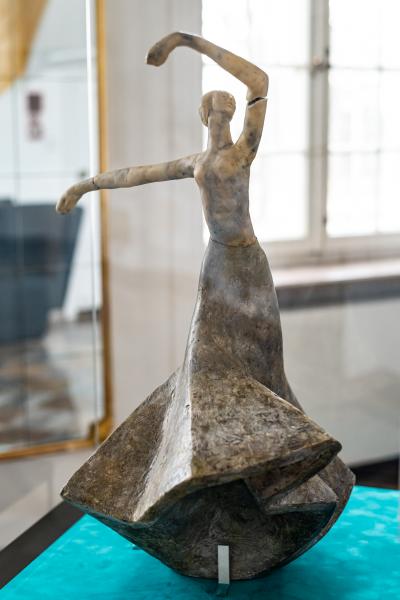
The figure of a woman in a long, voluminous skirt raises her arms gracefully above her head; her gaze turns to the sides. Kwapiszewska’s sculptural dance figure is made of plastic2. A personal encounter with the sculpture, which was part of the archive of the Chopin Museum in Warsaw, was Mastalerz’s starting point for her research, and inspiration to develop the choreography. Kwapiszewska made the dance figures as a reaction to her physical challenges when she was no longer able to work as a dancer and started sculpting. In a reaction to her health crises, which was simultaneously connected a crisis of her artistic practice, Kwapiszewska transformed her vulnerability. Autobiographical details of Mastalerz’s life intertwine with Kwapiszewska’s work and life: Both were born in Łódź and share Warsaw as the key location of their artistic practice and life. In both of their practices, too, the materiality of plastic expands to the history of art as material without history, and transcends time to the present.
The curator Marta Zaborowska (Chopin Museum in Warsaw) describes the materiality of the sculptures in detail: »The skeleton is made of steel wire braided with thin copper wire. The body is made of plastic, which was very popular in the 1970s. In the 1960s, it was embedded in a base, most likely made of plaster, covered with a layer of paint and locally with the material used to make the body.«3 In the 1970s, plastic became a common material in the arts, strongly associated with fragility and brittleness, which until today, challenges the objectives in the conservation of cultural objects. But how does the fragile material of plastic relate to the vulnerability of the body?
In the arts of the twentieth century, plastic is a »material without history.«4 It came into use during the time of the historical avant-gardes, and after World War II, plastic became an everyday material. In Mythologies (1957), Roland Barthes states: »Plastic is completely absorbed in its use; in extreme cases, objects would be invented for the sake of the pleasure of using plastic. The hierarchy of substances has been destroyed, replaced by a single one: the whole world can be plasticized.«5 As a material without history, plastic is consumed in its use. In its dissolution it becomes brittle, dissolves, and disappears. Kwapiszewska’s sculptures share the same fate: Their surface becomes brittle, producing cracks, visible in the sculptural object. The material’s vulnerability becomes visible in the slender arms, the bent curves.
Mould’s title references »cast« and the act of casting as a sculptural process. In Kwapiszewska’s history, sculpting becomes the escape, or rather a last resort after dancing. While her sculptures seem to simply »revive« a pose, a gesture, Mould points to the restorative dimension of dancing and sculpting in moments of rupture. In the chosen format of a loop, Mastalerz aims to produce an infinite continuity, to blur interruptions. In effect, the opposite happens. Any moments of rupture rush to the fore: sudden movements of dancers, changes in light. Similar to the cracks and brittleness of Kwapiszewska’s dance figures that became visible over time, Mould recalls moments of restoration and rehabilitation.
With no documentation left of the choreographies that Kwapiszewska had conceptualized, Mastalerz’s film succeeds in blending the female body’s fragile state and the plastic material history of everyday life, by trespassing on the Polish history of dance – as they appear on stage, softly lit choreographically drafted bodies, who move and become sculptures, who move and begin to dance: MOJE RZEŹBY TAŃCZĄ ZA MNIE, WYSTAWA PRAC (transl. My Sculptures Dance for Me).6
Click here to see an image of the sculpture ‘Fantaisie-Impromptu by Fryderyk Chopin: The Dancer’ by Danuta Kwapiszewska.
Credits Mould (2025):
Concept and direction: Agnieszka Mastalerz
Director of photography: Marcin Gołąb
Second director: Kuba Gryżewski
Choreography & performer I: Adrianna Mrowiec
Performer II: Agnieszka Janosz
Production company: Papaya Films
Executive producers: Sebastian Jurczek, Tomasz Skrodzki
Producer: Małgorzata Kozieł
Production assistant: Zofia Kszczotek
Focus puller: Tomasz Czerwiński
2nd AC/ loader: Kuba Żukowski
Grip: Piotr Wicik, Adrian Kubicki, Marek Rumak
Gaffer: Grzesiek Strzelecki
Lighting technicians: Kamil Gajewski, Artur Nowak
Set rigging: Mikołaj Miłkowski
Costumes: Monika Tomczak
Make-up: Aneta Paciorek
PJM interpreters: Magdalena Schromova, Elżbieta Żurawska
Stills: Oliwia Zając
Camera equipment: Panavision
Lighting equipment: Heliograf
Studio: Transcolor Lucjan Siwczyk
On-set sound: Alex Banaszkiewicz
Sound post-production: Natalia Ptak (ptakova)
Post-production: BlackPhoton (Kamil Rutkowski, Michał Krajewski, Maciej Mika, Andrzej Hajdaniak)
Post-producer: Zosia Krajewska
Conforming: Bartłomiej Kuszpit
Color grading: Hania Rudkiewicz
VFX: Julinna Lachowicz-Wróbel, Iwona Borucka
Mastering: Iwona Borucka
Film stock: Piotr Karniewicz, Kodak Polska Sp. z o.o.
Film processing & scanning: Film Laboratory / WFDiF
Film output: Cinelab Bucharest
Historical consultation on Danuta Kwapiszewska: Marta Zaborowska, Fryderyk Chopin Institute
Special thanks to Tomek Kozera, RIOTS Film
The project was realized thanks to the Young Poland scholarship program, granted by the Polish Ministry of Culture and National Heritage.
See Arleen Ionescu/Maria Margaroni (eds.): »Arts of Healing. Cultural Narratives of Trauma,« in: Critical Perspectives on Theory, Culture and Politics. London 2020.
»Danuta Kwapisyewska. Moje Rzeźby Tańczą za mnie, wystawa prac,« exhibition at Zachęta Narodowa Galeria Sztuki, December 12, 1984 – January 1, 1985.
Marta Zaborowska: »Fantaisie-Impromptu F. Chopina. Tancerka, Danuty Kwapiszewskiej« at Fryderyk Chopin Museum Warsaw, February 15, 2022 – April 10, 2022: https://muzeum.nifc.pl/pl/muzeum/wystawy-czasowe/58_15022022-10042022-fantaisie-impromptu-f-chopina-tancerka-danuty-kwapiszewskiej/1/ (accessed November 29, 2025).
Monika Wagner (ed.): »Lexikon des künstlerischen Materials,« Munich 2002.
Roland Barthes: »Mythen des Alltags,« Frankfurt am Main 1964, p. 81. »Das Plastik geht gänzlich in seinem Gebrauch auf; im äußersten Fall würde man Gegenstände erfinden um des Vergnügens willen, Plastik zu verwenden. Die Hierarchie der Substanzen ist zerstört, eine einzige ersetzt sie alle: die ganze Welt kann plastifiziert werden.«
See the exhibition Danuta Kwapiszewska, MOJE RZEŹBY TAŃCZĄ ZA MNIE, WYSTAWA PRAC“ (transl. My Sculptures Dance for Me), Galeria Kordegarda, 12.12.1984 – 01.01.1985.
Anna Kipke is an art historian and art critic. She is a member of the Collaborative Research Center 1512 »Intervening Arts« at Leuphana University Lüneburg and Free University Berlin. In her doctoral thesis, Emma Kunz. Therapeutic Lines, she examines how institutionalized art forms intersect with therapeutic practices in twentieth-century art. Most recently, she co-edited the volume Drafts in Action. Concepts and Practices of Artistic Intervention (Diaphanes 2025).
Agnieszka Mastalerz is a visual artist based in Warsaw/Poland. She studied at the Studio of Spatial Activities with Mirosław Bałka at the Academy of Fine Arts in Warsaw (MFA, 2018). In 2019/2020, she continued her studies at the Braunschweig University of Art with Candice Breitz and Eli Cortiñas on a DAAD scholarship. She uses a poetic visual language to analyze restrictive rules established within intimate relationships, communities, states or companies, and toward the natural environment.
© 2026 Akademie Schloss Solitude and the author
Beteiligte Person(en)